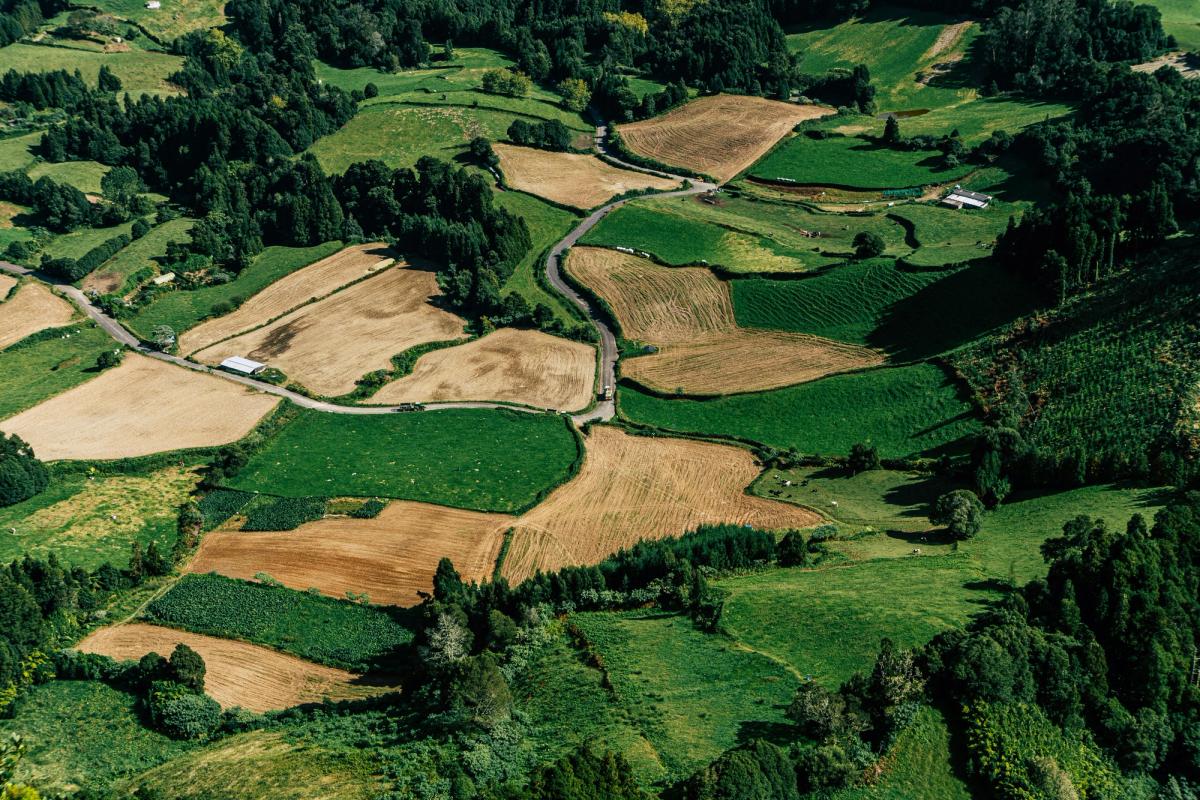
While mortgage rates and energy costs dominate headlines, a larger shift is reshaping rural Europe's economy. The EU's current Common Agricultural Policy (2023-2027) allocates €64 billion to rural development — with food chain integration and short supply chains as explicit priorities.
If you're eyeing village properties, this matters.
What Changed
The 2023-27 CAP made local food networks a core EU policy objective. Short food supply chains (SFSC) — farm shops, weekly markets, basket deliveries, producer cooperatives — now qualify for direct subsidies, infrastructure grants, and training programs under Focus Area 3A: "improving competitiveness of primary producers by better integrating them into the agri-food chain."
The goal: keep food production and profits local.
In February 2025, the Commission presented a new vision for EU agriculture built on the Strategic Dialogue conclusions. The emphasis: resilience, diversification, and strengthening the farmer's position in the food chain.
The Numbers
15% of EU farms sell directly to consumers. In some countries, the percentage runs higher:
- Greece: 25% of farms
- France: 21% (50% of vegetable/honey producers)
- Slovakia: 19%
- Hungary, Romania: 18%
France alone has 2,000 AMAP schemes (community-supported agriculture). Italy has 104 solidarity purchasing groups. Belgium has 138 CSA partnerships.
Direct sales currently represent just 2% of the EU fresh food market. The growth potential? Massive.
Why This Matters Now
Global supply chains keep breaking. Ukraine disrupted grain exports. Iran's war threatens oil and shipping routes. Energy costs spiked double digits in a week.
Local food networks kept functioning when imports didn't.
March 2025 research on SFSC highlights this explicitly: local food systems are now framed as tools for "smart villages" — communities that use digital infrastructure and local cooperation to build resilience against supply shocks.
Villages with active farmers markets, CSAs, and producer cooperatives have built-in crisis resistance. When oil hits $100/barrel, a village with weekly marchés doesn't worry about Spanish tomatoes stuck at a blockaded port.
The Smart Villages Framework
The EU's current rural development strategy centers on "smart villages" — communities that combine digital connectivity with local economic networks. SFSC form a pillar of this framework.
A 2025 academic study defines smart economy in rural areas as: increased income for farmers, circular economy principles (reduced waste, local resource use), and economic development independent of global supply chains.
Not nostalgia. EU policy for 2023-2027 and beyond.
The Infrastructure Test
Before dismissing a rural property as "too isolated," check for local food infrastructure:
- ✅ Weekly farmers market (year-round, not tourist-season only)
- ✅ CSA schemes (AMAP in France, GAS in Italy, RECIPROCO in Portugal)
- ✅ Producer cooperatives
- ✅ Farm shops within 20km
- ✅ Local food festivals (indicates active networks)
These aren't amenities. Economic engines.
Why This Works
Conventional food chains extract wealth. Farmers sell at a loss to supermarkets. Profits flow to corporate retailers. Rural areas hollow out.
SFSC reverses the flow. Farmers retain a larger share of the sale price. Money circulates locally. Jobs stay in the village. Young people have reasons not to leave.
The Commission's 2024 policy report found that strengthening local food systems creates cooperation between businesses and jobs in agriculture and food production — "particularly important for peripheral and disadvantaged regions."
Translation: Brussels finally noticed that when all the money leaves, villages die.
Regional Breakdown
France leads with the AMAP movement — 2,000 schemes where consumers pre-purchase seasonal shares directly from farmers.
Italy's Campagna Amica runs a national network of farmers markets. Yellow tents from Naples to Sicilian villages. Products labeled by origin. Government-backed infrastructure.
Spain lags at just 5% of farms in direct sales — but that's changing. New cooperatives launching. Digital nomads driving demand for local food. (Turns out remote workers want actual tomatoes, not supermarket cardboard.)
Portugal's RECIPROCO initiatives connect urban consumers with rural producers. Alentejo seeing growth.
The EU Money
€64 billion allocated to rural development (2023-2027) includes:
- Investment grants for farm modernization
- Cooperation subsidies for producer networks (Article 16.4: horizontal and vertical cooperation for SFSC establishment)
- Training programs for direct sales
- Infrastructure for local markets
- Smart village initiatives combining digital connectivity with local food systems
The European Food Security Crisis Preparedness Mechanism (established 2021, active through 2025) explicitly prioritizes "mitigating risks and vulnerabilities in food supply chains" — local networks as crisis buffers.
Because nothing says "preparedness" like discovering your entire food supply depends on oil tankers not getting blown up in the Strait of Hormuz.
Post-Crisis Reality
The policy shift has real context. EU meetings in 2024-2025 focused on supply chain resilience after COVID-19 and Ukraine disruptions. The July 2025 focus meeting covered "stockpiling in the agri-food sector" and "stress testing for the EU food sector."
Translation: The EU learned that global dependency creates vulnerability. Local food networks provide backup.
Or as one might put it: governments panic-bought canned goods in 2020 like everyone else, then decided to make policy about it.
What to Look For
When viewing properties, ask:
"Weekly market nearby?" Not just where — year-round? Tourist markets vanish in winter. Producer markets run all year.
"Any CSA schemes in the area?" France: AMAP. Italy: GAS. Portugal: RECIPROCO. These indicate organized local food networks.
"Do farmers sell direct here?" Farm shops. Roadside stands. "Pick your own." If yes, the village has working agricultural income.
"Smart village initiative?" EU funding often targets specific regions. Check if local authorities have received smart village grants.
The Anti-Gentrification Angle
Villages with SFSC have working economies, not museums.
Farmers earn fair prices. Money doesn't leave for corporate headquarters. Young farmers can make a living. Newcomers integrate through market participation, not displacement.
The opposite of "investment property" extraction.
The Vision
Europe is rewiring from globalized fragility to localized resilience. €64 billion (2023-2027) backs this shift.
The February 2025 Commission vision for agriculture explicitly states: "We'll help our agri-food system to withstand crises and seize opportunities by becoming more diverse, adaptable, and innovative. We'll prioritise food security, diversify supply chains, and work towards fairer competition."
When you buy a €200,000 property in Tarn-et-Garonne and there's a marché 15 minutes away, you're not just buying charm. You're buying into EU-subsidized infrastructure designed to function when global supply chains don't.
The Iran war just proved the point. Oil shocks. Shipping disruptions. Energy inflation.
Local food networks kept running.
Not romantic. Recession-proof.
Sources:
Primary Source: Short Food Supply Chains as a Policy Tool for Smart and Sustainable Rural Development in the European Union (March 2025) https://www.researchgate.net/publication/389746402_Short_Food_Supply_Chains_as_a_policy_tool_for_smart_and_sustainable_rural_development_in_the_European_Union
Policy Documents: Future of Agriculture - European Commission (February 2025) https://commission.europa.eu/topics/agriculture-and-rural-development/future-agriculture_en
Best Practices in the Agri-Food Supply Chain - EU CAP Network (September 2024) https://eu-cap-network.ec.europa.eu/sites/default/files/publications/2024-09/eu-cap-network-policy-insight-farm-to-fork_0.pdf
European Union Agricultural Policy Monitoring - OECD (2025) https://www.oecd.org/en/publications/2025/10/agricultural-policy-monitoring-and-evaluation-2025_354e7040/full-report/european-union_2e29a59b.html
Ensuring Global Food Supply and Food Security - EU Agriculture (2024-2025) https://agriculture.ec.europa.eu/common-agricultural-policy/agri-food-supply-chain/ensuring-global-food-supply-and-food-security_en
Foundational Research: Short Food Supply Chains and Local Food Systems in the EU - European Parliament (2016) https://www.europarl.europa.eu/RegData/etudes/BRIE/2016/586650/EPRS_BRI(2016)586650_EN.pdf